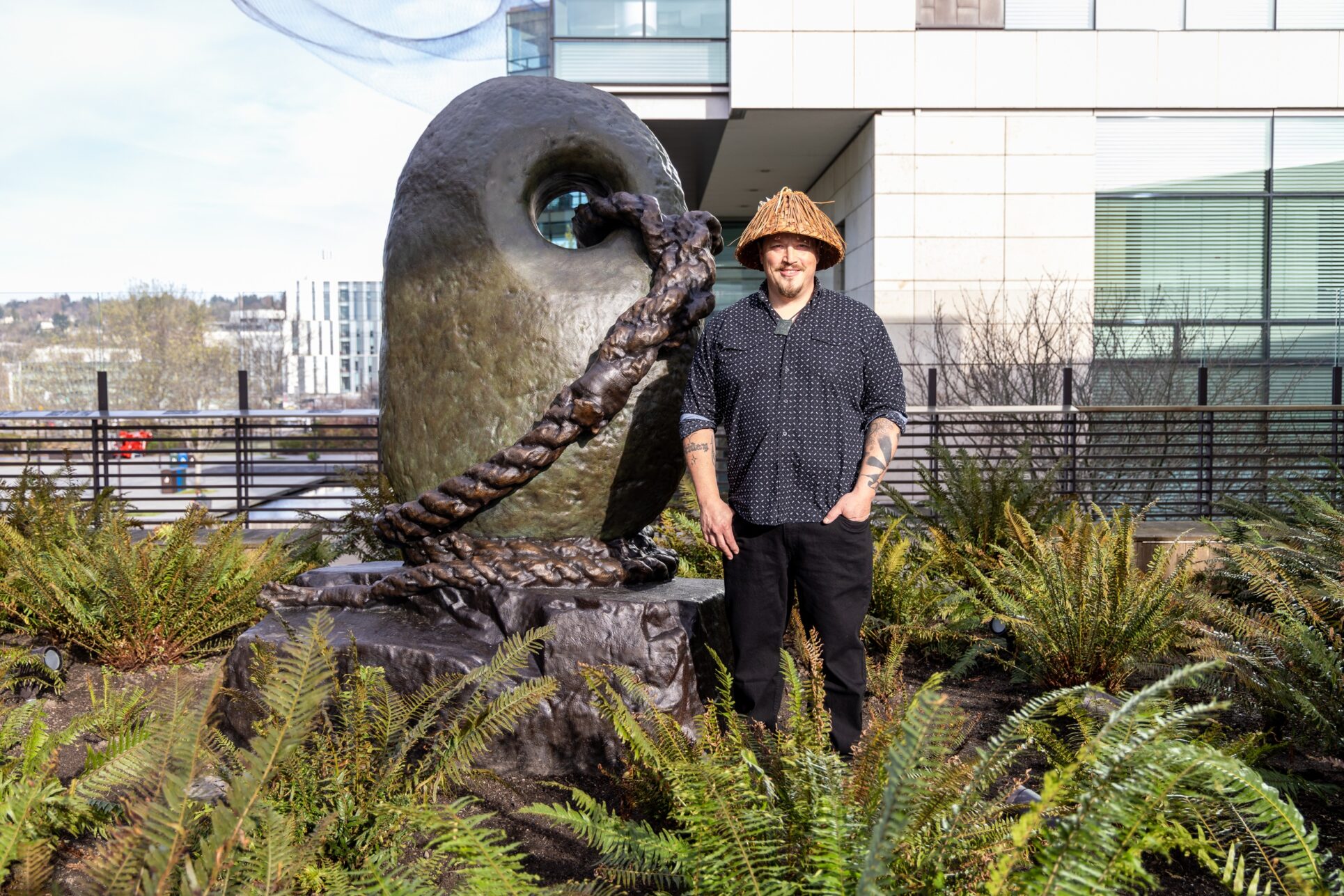
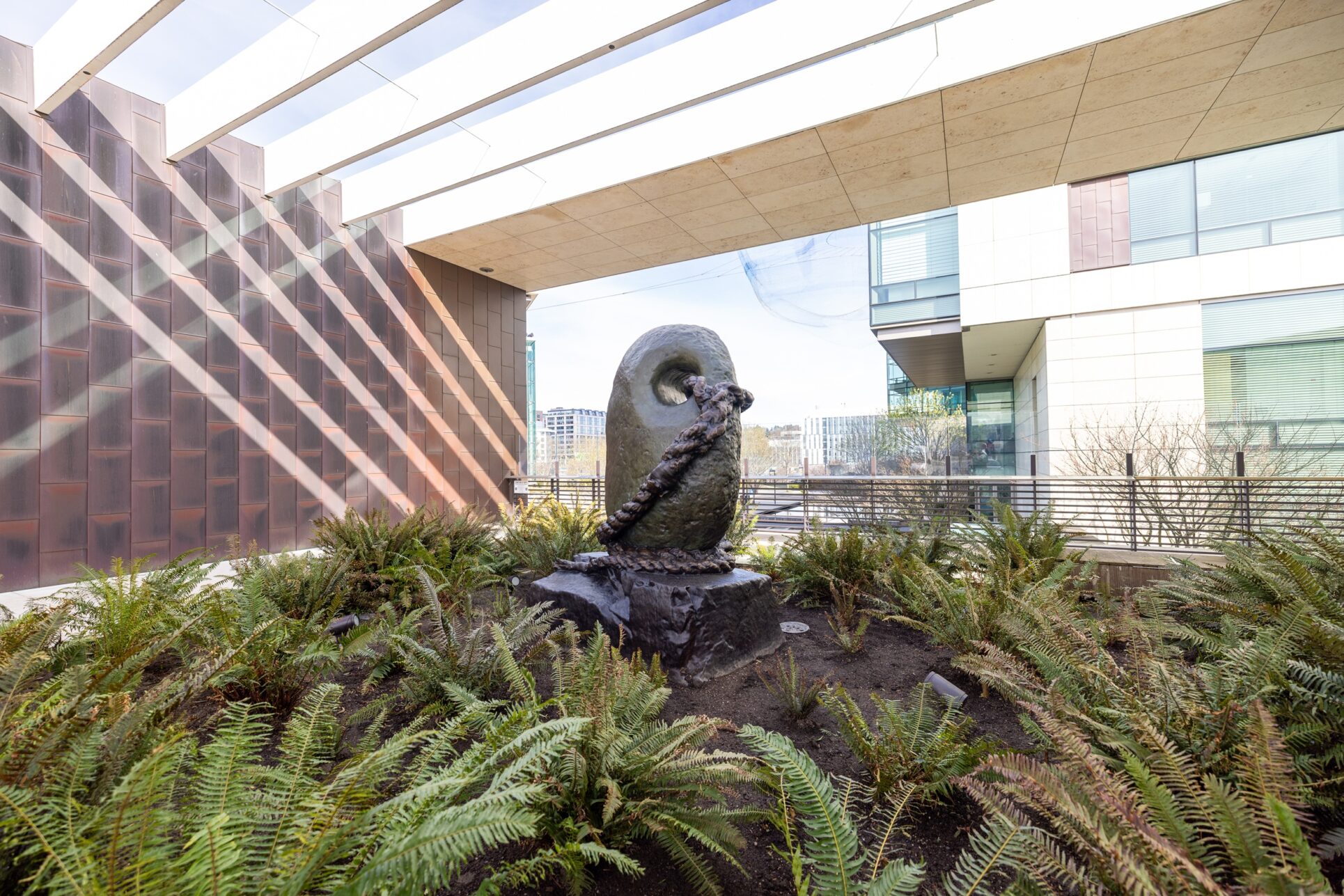
Survivors of the Flood Anchor draws on the form of traditional reef-net anchor stones used by the Coast Salish peoples. Friday transforms this working tool into a public marker of belonging and responsibility—grounding the campus in living Coast Salish history and enduring ties to land and water.
Historically, an anchor holds a ship steadfast against the currents. Symbolically, it represents security and foundation—speaking to one’s ability to ground oneself to a place.
Dan Friday
Cast in bronze, the piece emphasizes the anchor’s working logic—mass and balance—rather than literal hardware. It reads first as a tool, then as a marker: a reference to the reef-net system that held the sxwo’le in place and, by extension, to Coast Salish knowledge that sustained salmon fishing for generations.
History of reed-netting and the sxwo’le
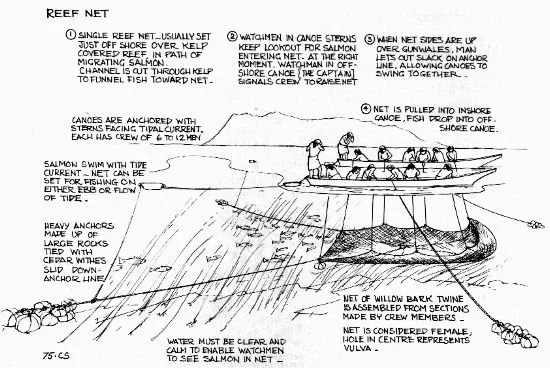
Reef-netting is a sophisticated Coast Salish salmon fishery once practiced widely in the islands and channels of the Salish Sea. Crews suspended a woven sxwo’le between two canoes (and, in later adaptations, platforms), guiding fish along artificial reefs toward a scoop-shaped net raised by hand. Heavy stone anchors—many still resting offshore—held the system steady against strong tidal currents. Friday’s bronze form echoes these anchors, honoring the ingenuity of the practice and the communities who sustain it today.
How reef-netting works (at a glance):
- Anchors secure the fishing lines and the mouth of the sxwo’le in the tide.
- Watchers read current, light, and fish behavior to time the lift.
- Teams haul the net together—an act of skill, coordination, and community.
Over time, toolmaking and technique adapted to currents, sites, and seasons. The enduring presence of anchor stones along shorelines speaks to a long continuity of knowledge—one grounded in careful observation and shared labor.
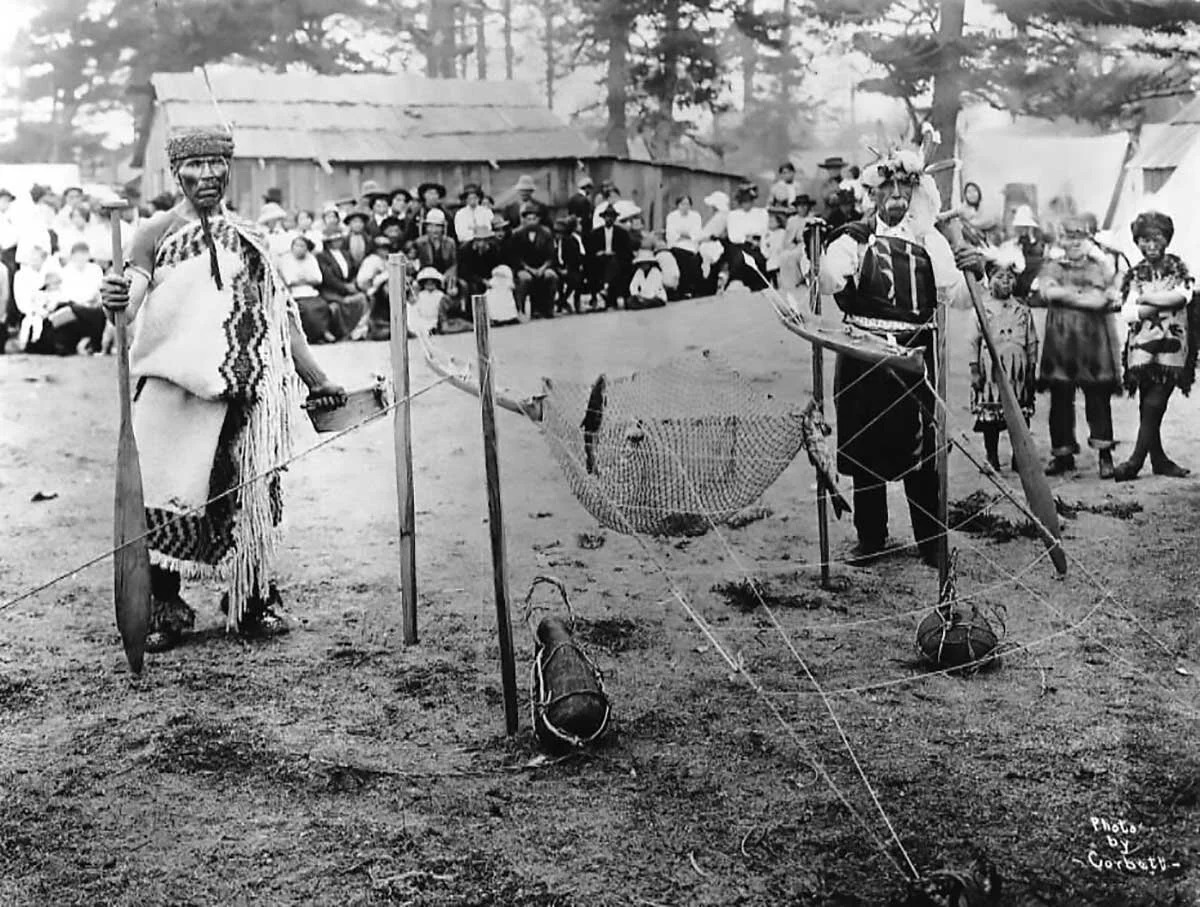
-

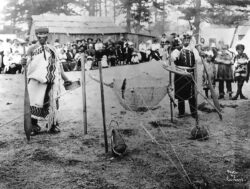
Lummi Nation image ca. 1915. Image curtsey of Dan Friday, -

Reef-net diagram
Themes
Steadfastness — An anchor as a public metaphor for security and grounding amid constant movement.
Memory in Place — Acknowledging Coast Salish peoples and the histories embedded in these waters and shorelines.
Resilience & Continuity — Referencing a fishing practice disrupted by policy yet carried forward through cultural knowledge and community leadership.
About the Artist
Dan Friday (Lummi Nation) is a Puget Sound–born, Seattle-based artist whose work draws from Coast Salish cultural themes through modern processes. Over the past two decades he has worked with Dale Chihuly, Paul Marioni, and Preston Singletary, and he maintains an independent glass studio in Seattle. His work appears in collections around the world.
He has taught at the University of Washington, Pilchuck Glass School, Haystack Mountain School of Crafts, and The Studio at the Corning Museum of Glass; past residencies include the Museum of Glass (Tacoma), the Burke Museum (Seattle), CMoG’s Studio, and the Dream Community in Taipei. Recurring motifs in his practice—baskets, salmon, totems—translate ancestral knowledge into contemporary form. Recent highlights include the entry installation for the Seattle Aquarium’s Ocean Pavilion and a stint as a contestant on Netflix’s Blown Away (Season 3). Awards include the Artist Trust Fellowship (2020) and the SWAIA Discovery Fellowship.

-

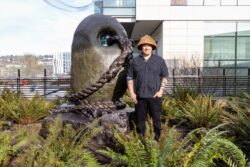
Lummi Nation artist Dan Friday poses with his sculpture, “Survivors of the Flood Anchor,” at the Gates Foundation in Seattle, Washington, on March 25, 2025. -

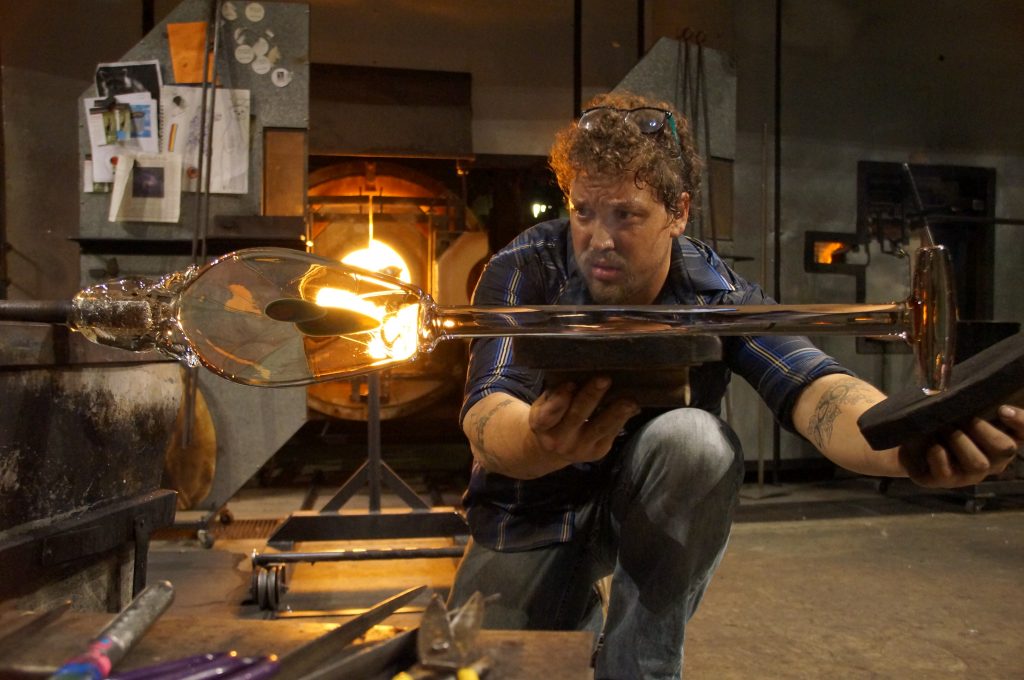
Artist Dan Friday works in the studio.